
The High Cost of "One More Thing"

There is a silent, flickering moment—right before the body gives out—when you know you should stop. It’s the moment the joy of the task turns into the grit of the teeth. But instead of listening, we negotiate. We tell ourselves we’re fine. We remind ourselves we’ve survived worse.
We promise we’ll collapse just as soon as we finish one more thing.
We treat our bodies like machines and our energy like a debt we can endlessly refinance. But eventually, the bill comes due.
The Seduction of Order

I found myself in that exact place recently. I was out in the yard, doing work I genuinely love.
There is something primal and satisfying about imposing order on chaos. Cutting through thick overgrowth, clearing away the dead weight, and reclaiming a space that felt out of control—it doesn’t just clean the yard; it clears the mind. For a while, it feels like peace. It feels like power.
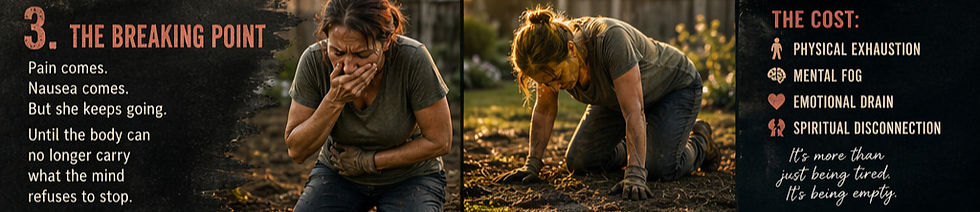
But somewhere between the first hour and the last, the satisfaction evaporated. My back stiffened, the sun grew heavy, and my breath shortened.
I was no longer working from a place of joy. I was working from a place of compulsion.
I had to stop and ask the question we usually avoid: Why am I still pushing?
The Ghost in the Pattern

The answer was honest, and it was uncomfortable.
For many of us, the drive to "push through" isn’t about the yard, or the deadline, or the chore. It’s about a legacy. If you grew up where rest was a luxury you couldn't afford—or where your worth was measured by the sweat on your brow—you learned to silence your body’s signals to survive.
You learned to override the pain to prove you were "enough."
The tragedy is that even when the environment changes, the ghost of that pressure remains. We are no longer being chased, but we are still running. We call it "grit" or "work ethic," but if we’re honest: Sometimes it’s just a survival mechanism we forgot to put down.
The Radical Act of Stopping
I am trying to unlearn the lie that my value is tied to my exhaustion.
I am learning to listen to the whisper before it becomes a scream. I am discovering that stopping isn’t a surrender—it’s a strategy. It is an act of healing to acknowledge that this body, which has carried me through every trauma and triumph, is not an obstacle to be overcome. It is a partner to be honored.
If you are white-knuckling your way through your day, telling yourself you’ll rest "when it’s done," I want to challenge that logic:
It is never truly done. But you are.
A Strength That Doesn't Drain

You don't have to earn the right to breathe. You don't have to be at the point of collapse to deserve a seat at the table. There is room in a life of purpose for a life of pause.
“He gives strength to the weary and increases the power of the weak.” — Isaiah 40:29
There is a different kind of strength available to us. It’s not the kind that comes from squeezing more out of an empty tank. It’s the kind that comes when we finally stop performing and allow ourselves to be replenished.

The Challenge:
Today, don't wait for the "breaking point" to be your "stopping point." When you feel that first nudge to rest—honor it. See what happens when you stop trying to prove your worth and start actually living it.



One thing I appreciate about The High Cost of "One More Thing" is that it does not ask us to look away from uncomfortable truths. Awareness matters, but awareness should lead somewhere—toward compassion, safer choices, stronger boundaries, and support.
This one deserves a real conversation. The High Cost of "One More Thing" raises the kind of issue people often carry quietly, and silence can make hard things feel even heavier. What part of this message stayed with you after you finished reading? One line of thought from the post that especially deserves reflection is this: There is a silent, flickering moment—right before the body gives out—when you know you should stop. It’s the moment the joy of the task turns into the grit of the teeth. But instead of listening, we negotiate. We tell ou…
Discussion prompt: What part of “The High Cost of "One More Thing"” stayed with you after reading—and why do you think that part mattered?
The challenge is to make the first nudge your stopping point instead of waiting for collapse. What boundary could help you honor that nudge today?
Many people learned to connect worth with exhaustion. What truth helps you remember that rest is responsible stewardship, not laziness?