
After a Survivor Speaks: 7 Ways to Become a Safe Place to Land

When a survivor finally tells the truth, the first response can become part of the wound—or the beginning of safety. Ending silence matters. What happens in the next few minutes, days, and weeks matters too.
Yesterday, we wrote that awareness is not enough. Today, we are taking the next stitch: learning how to become a safe place to land when someone speaks.
A Biblical Posture: Listen Before You Answer

“Wherefore, my beloved brethren, let every man be swift to hear, slow to speak, slow to wrath:” — James 1:19, KJV
That instruction is especially important when someone shares something painful. We may feel shocked, angry, frightened, confused, or eager to fix everything. But the survivor should not have to manage our reaction while trying to tell the truth.
A safe response begins with humility: I will listen. I will not make this about me. I will not demand that you prove your pain before I treat you with care.
1. Believe Without Taking Control

Believing a survivor does not mean making every decision for them. Abuse often involves the loss of power, choice, and personal agency. A helpful response should not repeat that pattern under the name of rescue.
Begin with words such as: “I am glad you told me.” “I am sorry this happened.” “You did not deserve it.” “What would help you feel safer right now?”
Do not make promises you cannot keep. Do not launch a public confrontation. Do not share the disclosure with others unless safety, mandatory reporting obligations, or the survivor’s permission requires the right people to be involved.
2. Listen Without Interrogating
A survivor’s story may not arrive in perfect order. Trauma can affect memory, language, emotion, and the ability to explain events chronologically. A person may remember one detail clearly and struggle to describe another. They may speak calmly, cry, become angry, laugh nervously, go quiet, or seem detached.
Your job is not to conduct an investigation. Your job is to listen carefully, avoid blame, and help identify the safest next step.
Questions such as “Why didn’t you leave?” “Why didn’t you tell sooner?” or “Are you sure?” can sound like accusations. Better questions are: “What do you need from me?” “Are you safe today?” and “Would you like help finding support?”
3. Protect Their Story

A disclosure is not content, gossip, a prayer-chain announcement, or an opportunity to prove that we were right about someone. It belongs to the person who lived it.
Protect confidentiality as far as safety and the law allow. If information must be shared, explain why, what will be shared, and with whom whenever possible. Surprises can deepen fear and mistrust.
Churches, families, ministries, workplaces, and advocacy groups must resist the temptation to protect reputation at the expense of a person. Silence that protects an institution is not biblical peace. Truth and safety must matter more than appearances.
4. Do Not Rush Forgiveness, Reconciliation, or Access
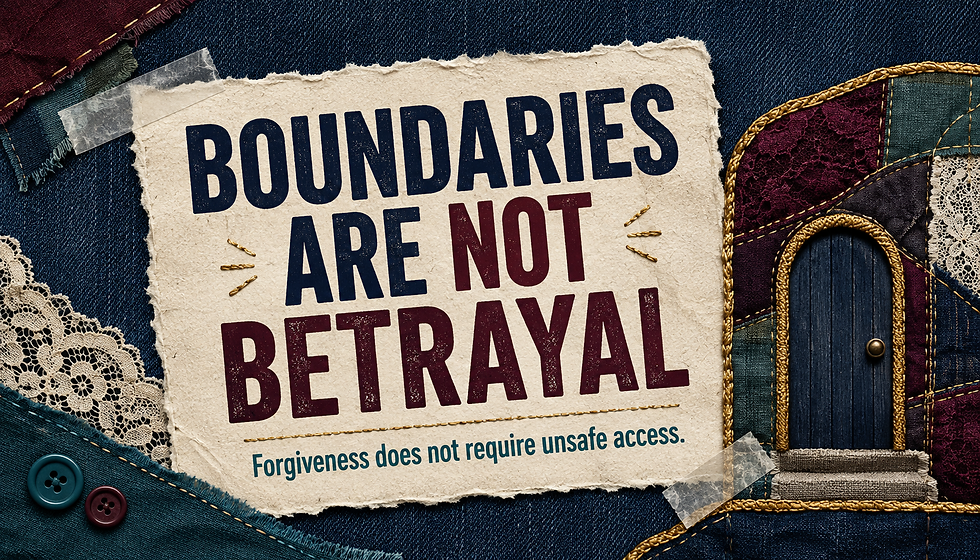
Forgiveness, reconciliation, and restored access are not the same thing. A survivor can seek God, release vengeance to Him, and still maintain firm boundaries. Reconciliation requires truth, repentance, accountability, safety, and changed behavior. Access to a survivor is not proof of grace.
Do not pressure someone to meet with an alleged abuser, answer messages, return home, withdraw a report, attend family gatherings, or “keep the peace.” Peace built on forced silence is not healing.
5. Offer Practical Help, Not Vague Promises
“Let me know if you need anything” can place another burden on someone who is already overwhelmed. Offer specific, manageable choices instead.
You might offer to sit with them while they make a call, help organize questions for an appointment, provide transportation, bring a meal, locate reliable resources, document important information, or accompany them to a safe public place.
Ask before acting. A small practical stitch, offered consistently, may be more helpful than a dramatic promise that disappears tomorrow.
6. Respect the Pace of Healing

Survival is not the same as healing, and healing rarely follows a straight line. A survivor may feel strong one day and overwhelmed the next. They may grieve people who harmed them, miss a family system that was unsafe, question themselves, or need to repeat parts of the story while making sense of what happened.
Do not measure healing by how quickly someone becomes comfortable for everyone else. Be patient. Encourage healthy support. Celebrate honest progress without demanding a performance.
7. Know the Limits of Your Role
Compassion does not require pretending to be a therapist, attorney, investigator, medical professional, or crisis responder. We can care deeply while recognizing when trained help, emergency assistance, legal guidance, pastoral care, or specialized advocacy is needed.
If someone is in immediate danger, safety comes first. Help them reach appropriate emergency or professional support. Do not place yourself or the survivor at greater risk by improvising a confrontation.
END SILENCE exists to help people find truth, support, healing tools, community, and the next available step. We are part of a larger safety net—not a replacement for every form of care.
What a Safe Landing Sounds Like
A safe landing may sound like this:
“I believe you. I am sorry this happened. You are not responsible for another person’s choice to harm you. You do not have to decide everything today. Let us take the next safe step together.”
Those words do not solve every problem. But they remove blame, restore choice, and remind the survivor that they are not standing alone.
The Next Stitch Is Ours
We often ask why survivors remain silent. We must also ask whether our homes, churches, organizations, and communities have shown that truth will be received with wisdom, courage, confidentiality, and care.
If we want people to speak, we must become safer listeners. If we raise awareness, we must build support behind it. If we say every child and every survivor matters, our response after disclosure must prove it.
Today’s action is simple: share this article with one person who may someday be trusted with someone’s truth. Talk together about what you will—and will not—do when that moment comes.
Read the companion article, “Awareness Is Not Enough: What Comes After We END Silence,”

KEEP THE THREAD GOING
The article may end here.
The work does not.
Choose your next stitch.
END SILENCE • ARMOR UP • HEAL BEAUTIFULLY

One thing I appreciate about After a Survivor Speaks: 7 Ways to Become a Safe Place to Land is that it does not ask us to look away from uncomfortable truths. Awareness matters, but awareness should lead somewhere—toward compassion, safer choices, stronger boundaries, and support.
This one deserves a real conversation. After a Survivor Speaks: 7 Ways to Become a Safe Place to Land raises the kind of issue people often carry quietly, and silence can make hard things feel even heavier. What part of this message stayed with you after you finished reading? One line of thought from the post that especially deserves reflection is this: After a Survivor Speaks When a survivor finally tells the truth, the first response can become part of the wound—or the beginning of safety. Ending silence matters. What happens in the next few minutes, days, and weeks m…
Discussion prompt: What makes truth hardest to say out loud—fear, shame, loyalty, uncertainty, or something else? What helps create enough safety to begin?
I appreciate that this does not ask anyone to fix everything at once. The whole series keeps bringing it back to one stitch, one truth, and one next step.
A useful question after reading “After a Survivor Speaks: 7 Ways to Become a Safe Place to Land”: what is one thing I can notice, say, or do differently because of this message?